

I was recently studying the financials of a company I’m thinking about investing in. In short, here is a summary of a few numbers I want to point out.
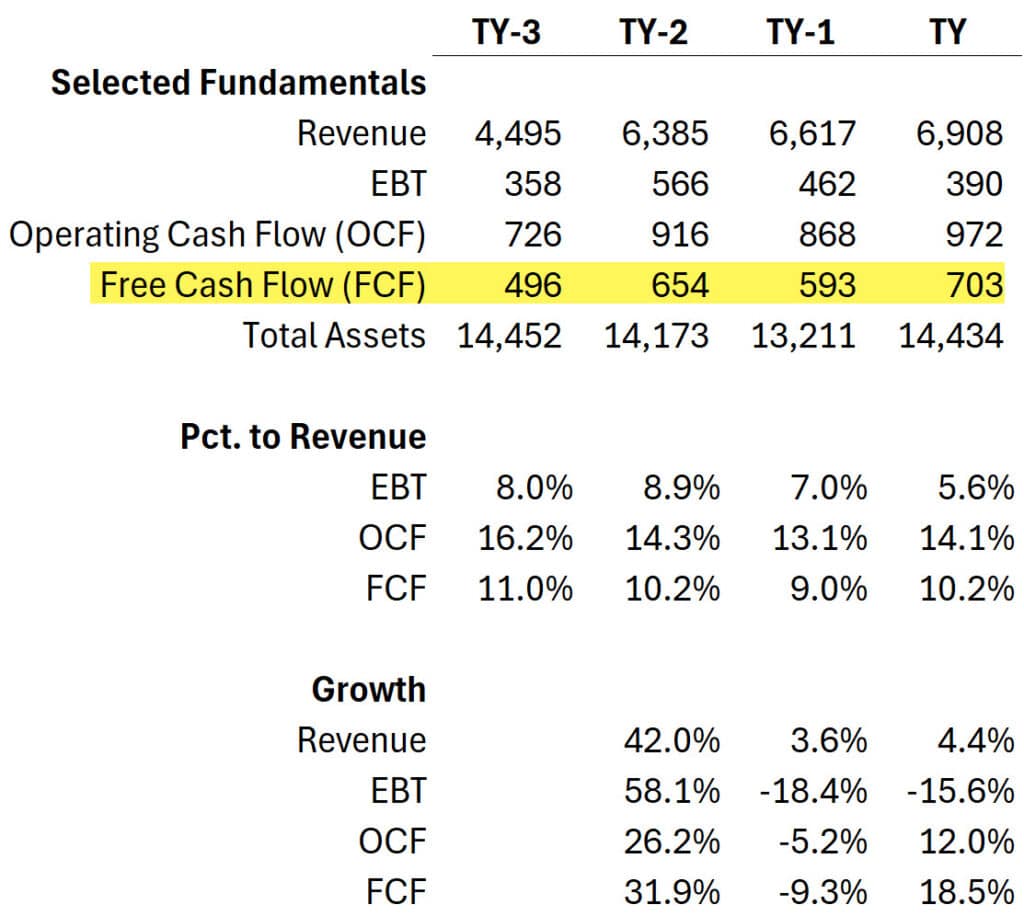
Apologies, I don’t have a few of the most important numbers: the number of clients, the typical transaction size, and the number of transactions (or something similar for this service-based organization).
What do you notice? Before I provide my biggest insight, this company acquired a large competitor, and assimilating it post-transition has been difficult and rocky. But the bumpiness is behind them. Also, their total assets are inflated by goodwill, so their ROA over the next few years will look ugly.
At first, I loved this company’s backstory along with its missionary-type leader. That changed when I looked at their EBT, which ranged from 8% to under 6%, and that number has been falling.
Then I looked at OCF. “What the …?”Oh, it’s because of some one-time charge-offs and high amortization from an acquisition.
Then I looked at their FCF. It’s wrong. Or, it should be. Sure, they are using the textbook formula for FCF, but try explaining that to a high-dopamine CEO growing their small $20 million business 20% per year. That definition of FCF will lead to some very bad decisions because it’s a misleading measure given how it’s calculated. Let’s get this right for the small business owner.
Three questions we’ll revisit:
- What is free cash flow, and why does it matter? That is, now what? What do we do with that number?
- What is the right way to calculate it in a small business, and why does it matter?
- How often should we revisit this number? Hint: We focus more on OCF than FCF, although FCF is critical for growth-oriented businesses.
After answering these three simple questions, we’ll apply the three words that clearly define free cash flow.
G3VIP
To read this article, you need to log in as a G3VIP.