
As I’ve reached a new season in my long consulting career, I feel lucky to have worked with a small number of impactful nonprofits whose missions are moving and meaningful.
I’m also wise enough to know that my contributions to these organizations have been limited by my narrow range of capabilities. While I will never have the vision and big-picture thinking of the executive directors of these mission-centric organizations, where profit is not the primary driver, I do know a thing or two about their back office.
Inspired by a great writer more than 2,000 years ago, I like saying the following in small group settings:
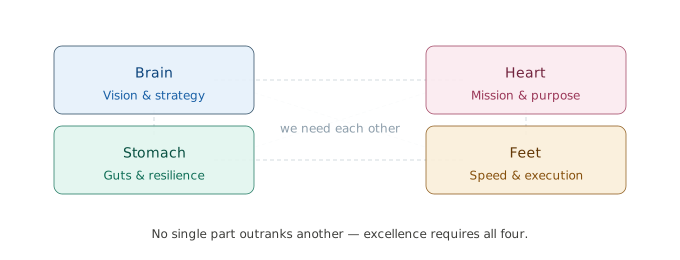
- The brain can’t say to the heart, “I’m smarter than you.”
- The heart can’t say to the stomach, “I have more heart than you do.”
- The stomach can’t say to the feet, “I’ve got more guts and grit than you do.”
- And the feet can’t say to everyone else, “I can outrun you all.”
Just like Daniel James Brown’s Boys in the Boat, we’re all one. We need each other. Every single person is required to achieve excellence. The innovator is useless unless he has producers and stabilizers to make the dream real and recurring. Producers and stabilizers are unemployed without the innovator.
And this paragraph concludes my introduction to a great back office at a healthy nonprofit organization. A great front office needs a phenomenal back office to further its mission in ways it never dreamed before.
The Front Stage Needs a Great Backstage
The greatest small business coaching organization in the world is The Strategic Coach, founded by Dan Sullivan. I attended their workshops over a three-year period, and at the time, those first twelve quarters were called Foundations.
My workshop facilitators were Gary Klaben and Ross Slater. Frequently, they would use the terms “front stage” and “backstage.” While there is not enough space to write about the context behind the usage of these words, I always got it. Those terms were tangible and vivid in my mind.
Accordingly, every great non-profit has a great front stage. That front stage could be their annual gala or their large social media following on Facebook or Instagram. When staff or volunteers talk about their non-profit, they are typically talking about the front stage.
Look at any non-profit’s mission statement, and it’s adorned by front-stage language. But what about the backstage? If we refer back to the concept of unity and the human body, we can never say the front stage is more important than the back stage. And the backstage in these organizations can never say, “I’m more important than the front stage.”
Instead, let’s start with two very true statements:
- The front stage needs the back stage to survive.
- The backstage has no job without a front stage.
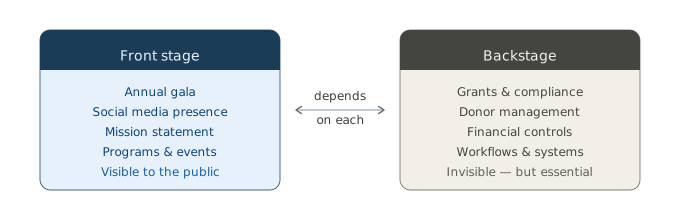
To summarize, the front stage needs a great backstage. My bigger point is that most nonprofits focus mainly on the front stage because it comes naturally to them. The backstage can be awkward, tedious, and frustrating. Unless we find ways to improve the backstage, I fear nonprofits, especially smaller ones, can never meet the potential of their mission.
Three Simple Tools for a Better Back Office and Backstage
From here on out, I’ll use “backstage” and “back office” interchangeably, but I’ll probably use the former the most because I like the sound of it.
Scott, Bill, and Joe are the three greatest CEOs I’ve ever served. Scott used to use the term ‘best in the world’ a lot. I don’t think he remembers, but I do. And those words have stuck in my mind.
When I’m working in a nonprofit, my mind keeps asking, “How can our backstage be the best in the world?” Besides, why not? I don’t mean in a prideful and arrogant manner. Instead, I’m thinking, shouldn’t the backstage have a great mission statement that supports the bigger mission statement that’s inspiring and moving?
If I could have my clients only read one book now and forever, it would be Brian Joyner’s Fourth Generation Management. I might allow them a follow-up book by Jim “Mattress Mack” McIngvale entitled Always Think Big.
My favorite business word is never explicitly addressed in the two books above, but both authors allude to the concept of excellence (Brian and Jim use the word “quality” instead).
My starting point for improving backstage operations in the non-profit organization is a simple question: What does excellence look like in our organization? Please reword this to better fit your organization. For instance, consider, “What does excellence look like backstage?”
This is not a question only for the executive director, let alone for her board of directors. This question is for everyone, regardless of title and pay level. It’s especially pertinent for those working backstage.
My Favorite Speech of All Time Included Several Objectives
The HP Way is easily one of the 25 best business books ever written. I’ve already written my opinions on that book over at CFO Bookshelf. David Packard lists seven objectives that he and his famous partner, Bill Hewlett, embraced.
If we roll back the clock to 1960, Packard shared a handful of objectives with HP’s operating managers in the company’s early years. In his opening lines, I loved how he started his speech, which every executive director should be able to relate to:
I want to discuss why a company exists in the first
place. In other words, why are we here? I think many people assume, wrongly, that a company exists simply to make money. While this is an important result of a company’s existence, we have to go deeper and find the real reasons for our being.As we investigate this, we inevitably come to the conclusion that a group of people get together and exist as an institution that we call a company so they are able to accomplish something collectively which they could not accomplish separately. They are able to do something worthwhile—they make a contribution to society (a phrase which sounds trite but is fundamental).
David Packard, 1960 speech delivered to HP managers
If we go back three more years to 1957, Packard listed five vital HP objectives at an IRE conference of radio engineers. Here is one of those objectives:
As a fourth objective, we have kept in mind that we have a responsibility to the community in which our business exists. We have encouraged our people to participate in community activities. We have given substantial financial support to educational and other institutions. in our community.
My second favorite tool for building a better backstage in a nonprofit is inspired by David Packard’s words and actions above. Determine and communicate four to six primary objectives for the backstage. They should be clear, simple to explain, and require little interpretation to execute the objectives.
Here’s a small homework assignment. Next time you meet with a nonprofit executive director, ask them to name the five or so objectives of their organization. I think I can guess what the response will be for smaller organizations. They might even ask, “What do you mean by backstage?”
If you need help with some ideas on backstage objectives, here are a few:
- We will use technology and smart workflows to streamline and continually improve the donation process, starting with our contributors.
- We will implement grant procedures leading to a GIP process (grants in process) that’s easy, lucrative, and fun.
- We’ll never lead and manage from a position of fear regarding financial capital, but we’ll never operate from a position of excess. We’ll know our sweet spot of cash reserves at all times.
- Regarding audits and other compliance requirements, we’ll be proactive and generally ready 30 to 45 days before reporting deadlines. We’ll never do ordinary work in a hurry or under stress.
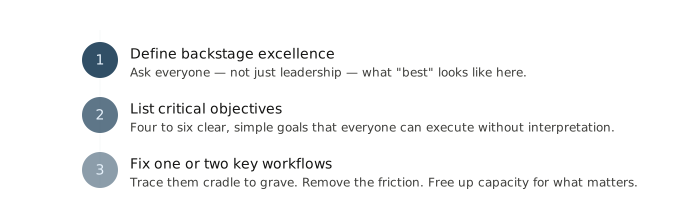
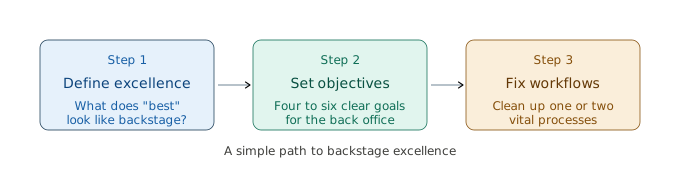
To recap where we’ve been, we start with the definition of excellence, and we continue with a handful of critical objectives for the backstage.
“That’s Not The Way It’s Done Around Here”
Every nonprofit has its way of doing business in the back office or backstage. An organization like the United Way, whose back office is probably the best at funneling money from contributors to recipients, has systems and processes that would be hard to improve.
If you and I were to tour several nonprofit back offices, we’d probably hear “That’s the way it’s done around here” a lot when quizzed about their most important workflows.
Speaking of workflow and processes, that brings me to my last suggestion on back-office or backstage excellence in the nonprofit. Look at two or three of the most vital processes from cradle to grave and determine what can be improved or removed from the workflow. The people doing the work will have many ideas. If done well, the ultimate outcome is not just a better process. Backstage capacity is freed to do more work or other work at the same cost.
Another outcome is that staff working on terribly inefficient processes will enjoy their work more, with the potential to have more time to do other work that could not be done beforehand.
Before I leave this third and final suggestion, let me finish with a brief story from a long-ago past experience. I used to run an internal audit department, and I observed many “That’s the way we do it around here” attitudes. Low-hanging fruit improvements were within these people’s grasp, but they wouldn’t reach for them.
Lesson learned: it might take the leader to stoke the fire of interest in back-office or backstage excellence before improvement can get started.
Did I Get This Right?
Let’s recap. Three ideas to create a better backstage to support the front stage include the following:
- Clearly define backstage excellence. What is it and why?
- List a few critical objectives of the backstage.
- Fix or clean up one or two backstage workflows that require attention.
What did I leave out? What needs to be tweaked? I’d love to know. Below is a quick recap of the three suggestions.