

Danita is one of my all-time favorite business owners (she’s actually the co-owner of her business with her husband). Danita loved the book Good to Great, so she set a BHAG and shared her dream number with everyone in her small business.
I’m going to assume you know what a BHAG is, and the lazy part of my mind assumes Jim Collins, of Good to Great fame, coined the term. Let me know if I’m wrong. A BHAG not only sounds cool, but the concept is so seductive; how can an owner not grab hold of that concept and use it as a yardstick for their business?
That’s precisely what Danita did. Her team initially rallied around Danita’s enthusiasm. And then she told me. Sorry, but I was a Debbie Downer. Not only did I think her BHAG was unattainable, but I also found it uninspiring; however, it led to an essential conversation that altered Danita’s thinking.
I didn’t suggest we throw away her BHAG. I wanted her to think about the future differently.
Drat, Somebody Already Thought of My Idea
Several years ago, I interviewed Dean Spitzer on my podcast. The topic was transforming performance measurement, the title of his book. I reread the section on the dark side of numbers, and we hit that topic hard during our conversation.
Since that conversation, the ‘dark side’ is constantly on my mind, and I find myself pairing that term with nearly every management concept I encounter, including BHAGs.
When I decided to write about this topic, I had the ‘Dark Side of BHAGs’ on my brain, thank you, Dean Spitzer. Before I typed my first word, I was compelled to do a Google search for the ‘dark side of BHAGs’ out of curiosity. I was convinced I’d get no hits. Wrong, wrong, wrong.
Well, I suppose great minds think alike. Or maybe the author read Dean’s book, too.
I agree with the author’s reasons why BHAGs can go wrong:
- We can miss the small picture(s) by being overly fixated on the big goal
- They can be impossible to reach
Yet, the concept sounds so good, so inspiring, so healthy. Shouldn’t everyone have a goal of running a 4-minute mile? Maybe if we play sports.
The Alternative to Delusional BHAGs
I didn’t play any mind games with Danita. I merely altered the conversation.
Instead of one big, hairy goal, we changed the conversation to milestones.
Danita:
- “When do you want to retire or leave the business?
- How about a firm where all your reps are making at least $125k annually?
- You’ve been stuck on 20k-23k subscribers for years. How about 30k, 40k, and 50k? All of those numbers are achievable based on similar products in her niche industry.
- When can we generate 80% of our revenue from online sources?
- When can we launch that book publishing arm that requires minimal effort on our part?
- How about starting that award-winning podcast that more than offsets the cost of production?
I’m no management savant, but I prefer milestones over BHAGs. We can obviously build goals into our milestones, but these stepping stones now give us a starting point for what to do next.
In the questions above, there is nothing delusional about these milestones. They are specific, requiring only a simple action plan and the prioritization of each.
My Other Concern With BHAGs
There is an entire subgenre of learning books, and one of my favorite topics in this category is mastery. If you read widely, Robert Greene’s Mastery may be the first title that pops into your mind. My favorite title related to mastery is somewhat under the radar: Mastery: The Keys to Success and Long-Term Fulfillment by George Leonard.
Leonard turned a popular Esquire article into a gem of a book on the steps to mastering any new learning, whether it’s a hobby, a new professional skill, or something else. In the introduction, Leonard warns readers about a bottom-line mentality that prioritizes quick, easy results over long-term dedication to the journey itself.
… the quick-fix, fast-temporary-relief, bottom-line mentality doesn’t work in the long run, and is eventually destructive to the individual and the society. If there is any sure route to success and fulfillment in life, it is to be found in the long-term, essentially goalless process of mastery.
Leonard, George. Mastery: The Keys to Success and Long-Term Fulfillment (pp. xii-xiii). Penguin Publishing Group. Kindle Edition.
Based purely on other conversations similar to Danita’s, embracing and preaching a BHAG is easy, seductive, and can be inspiring. And then what? Thud. At least that’s been my experience.
Even well-intentioned CEOs who are growth-at-any-cost leaders could pull a page from a playbook that pairs milestone thinking with mastery.
Imagine, for a minute, listing your two to three significant milestones and determining the mastery required to hit them.
Milestone Visual Thinking
In Danita’s case above, I sketch something similar to the following. And yes, it’s messy, but this is a case of function over form. We’re thinking milestones. There is nothing wrong with appending a date to each milestone, but any leapfrogging beyond the first is hard to determine.
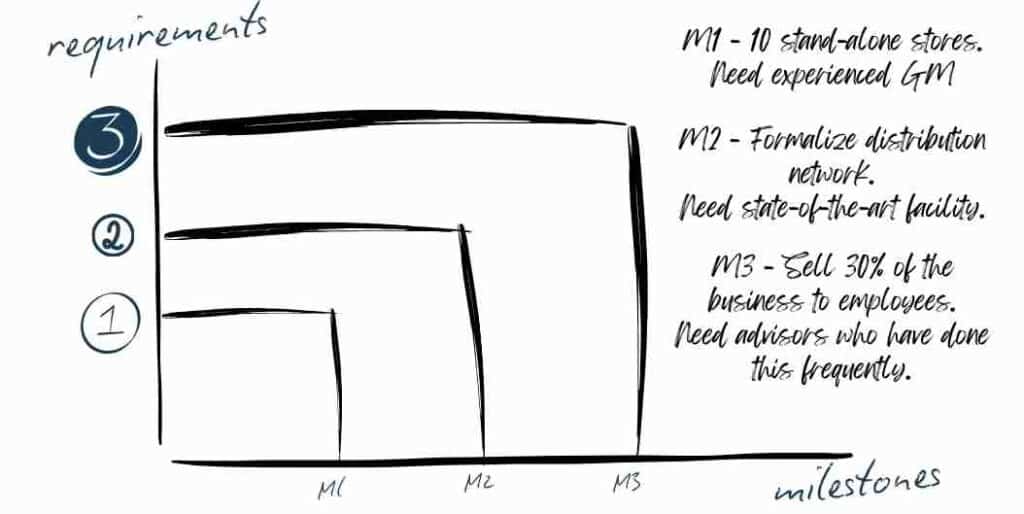
On the x-axis, we’re answering the question, “What do I want to accomplish?” The y-axis answers the capabilities and/or resources needed to hit that milestone.
This is one of those exercises that should only take a few minutes. If longer, I fear you are overthinking the concept and the milestones.
Your first question might be, “What do I do next?” Once you’ve identified milestone one and the capabilities required, you’ve won more than half the battle. You now know what to do next.
By the way, don’t forget the section on mastery above. Just because you’ve identified the requirements above doesn’t mean there will be smooth sailing ahead. Start by determining the steps to mastery before each milestone. Again, I recommend the book Mastery: The Keys to Success and Long-Term Fulfillment by George Leonard.
It’s Your Turn
I’m willing to accept some pushback. BHAGs or milestones? Which do you prefer?